You've asked "should I quit?" a hundred times.
Answer it for real — this weekend.
A licensed therapist's step-by-step decision workbook that ends the 2am spiral — by turning your bad days, your good days, and your gut feeling into evidence, a clear direction, and a 30-day plan.
Get the Workbook — $37 Instant digital download · Work through it in two sittingsYou've had this conversation so many times, your best friend answers on autopilot.
On the bad days, everything in you screams leave. You draft the resignation letter in your head during the meeting. You calculate how many more Sundays you can survive the chest tightness.
Then a good week comes. Your manager is warm. A project goes well. And you wonder if you invented the whole thing — if you're being dramatic, if you should just be grateful, if maybe you're the problem.
So the question stays open. And an open question doesn't cost nothing. It costs your sleep, your focus, your evenings, and the version of you the people you love used to get.
Here's what nobody has told you:
You're not indecisive. You've been handed an unanswerable question. "Should I quit?" is not one question — it's five. And your brain can't answer a five-part question phrased as a coin flip. So it loops. Not because it's broken. Because it keeps getting an impossible prompt.
Three real reasons you haven't been able to decide — and none of them are about your worth.
You're deciding with a dysregulated nervous system.
Chronic workplace stress keeps your body in survival mode — brilliant at reacting, terrible at deciding. Bad days scream "leave," calm days whisper "it's fine." Neither state can see the whole picture on its own.
You're asking a yes/no question about a dozen variables.
Is it this person, or this place? What is it actually costing me? Could it change? What does the evidence say? What do I do first? Five different questions — and you've been trying to answer them all at once.
The ambivalence is protecting you.
As long as the question stays open, you don't have to grieve, do the money math, or become "the person who left." The loop feels like agony — but it's also a waiting room. And waiting rooms feel safer than exam rooms.
The spiral doesn't end with more thinking. It ends when you replace it with data.
Stay or Go: The Decision Workbook
A structured, therapist-designed process that breaks the impossible question into five answerable ones — and walks you through them, in order, until you have a direction your own evidence supports and your body recognizes as true.
Not a verdict handed to you by a workbook. Not a pros-and-cons list you'll argue with by Tuesday. A decision you derive — from your own scores, your own numbers, your own patterns — plus a concrete 30-day plan for whichever direction you land on.
Designed to be completed in two 90-minute sittings, with a night in between so your answers get tested across a mood shift — exactly what a chronically stressed nervous system needs.
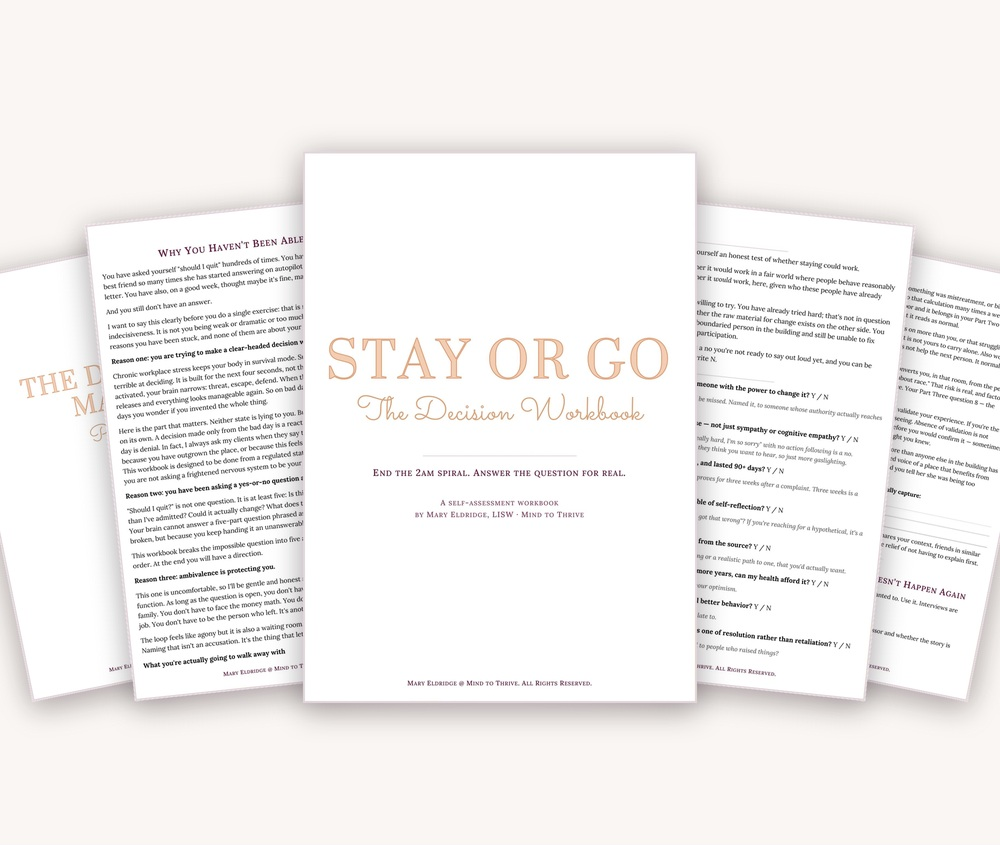
Five parts. Five answerable questions. One clear direction.
Each part starts with a 2-minute regulation practice — so you're deciding from clarity, not survival mode.
The Problem or Pattern Audit
An 18-signal checklist that reveals whether you're facing a contained problem or a structural pattern. This distinction changes everything about your options — and almost nobody makes it before they start agonizing.
The True Cost of Staying
Staying feels free. It isn't. Score six domains — body, mind, relationships, money, time, identity — with real numbers, including the salary gap, the coping spend, and the unpaid hours. Then run the two-year projection people quote back years later.
The Fixability Test
Ten yes-or-no questions that measure whether the raw material for change exists on the other side. Because you can be the most patient, skilled, well-boundaried person in the building and still not be able to fix what was never in your jurisdiction.
The Decision Matrix
Your three scores meet in a grid that turns them into one clear direction — stay and fix, test it, or go — plus an integrity check that reads your body's response, and a sorter that finally separates fear from wisdom.
Your 30-Day Plan
A different week-by-week plan for each direction — boundaries and the direct conversation for Plan A, a goalpost-proof 90-day experiment for Plan B, and a quiet, strategic exit build for Plan C.
The Toolkit: scripts and calculators for every hard moment that follows.
Because deciding is step one — and you shouldn't have to improvise the rest.
This workbook is for you if…
It's a yes if:
- You've been asking "should I leave?" for months — or years
- Your bad days and good days give you opposite answers
- You've tried boundaries, transfers, or "waiting it out" and you're still stuck
- You want a decision built on evidence, not a mood
- You're ready to write things down and be honest with yourself
It's a no if:
- You want someone else to just tell you what to do
- You're looking for a substitute for therapy or legal advice
- You're in crisis right now — please reach out to a licensed provider first (call or text 988 in the US)
- You'd rather keep the question open than know the answer

Hi, I'm Mary Eldridge — licensed therapist, and the person your 2am spiral has been looking for.
I'm a LISW/LCSW and the founder of Mind to Thrive. In my coaching, I sit with high-achieving, high-performing women who are told — in a hundred quiet ways — that they're never doing enough, that they're not good enough, that they should do more and do better. Meanwhile, they're the ones holding their workplaces together, carrying entire teams on shoulders that were never meant to bear that much alone.
One question I always ask my clients when they say they want to quit: "Do you want to leave because you've outgrown the place — or because this feels unbearable and you're trying to escape it?" This workbook exists so you can answer that honestly, with your own evidence, and finally put the loop down.
Mind to Thrive · @yourBIPOCtherapist
What clients say about doing this work with Mary
These are real words from clients I've coached through exactly what this workbook walks you through — the spiral, the boundaries, the decision.
"You helped give me clarity to everything. I feel like I can finally sleep. It's been incredible."
"Work is no longer consuming me. I removed everything work related from my personal phone because after hours are mine. The texts, the emails, and the calendar can all wait. Taking steps to heal me have been so freeing."
"Now I have this calm. I feel like I'm doing better work, I feel like I'm spending better time with my husband rather than always thinking about work. It's easier to just break away."
"I was just thinking, I was like, well, it would have been so nice to do this in the beginning and then I wouldn't be in this situation."
"You go in thinking, these are the kinds of things I want out of this — and then other stuff happens instead, and it's better than you thought."
"Anytime something happens, like the things we've spoken about — they don't control my narrative. My work doesn't define who I am."
You've already paid far more than $37 to stay undecided.
The rumination hours. The Sunday-night dread. The coping spend — the takeout, the massages that undo one week of tension. The raise you didn't negotiate because you were too depleted to try. Part Two of this workbook will show you the real number — and for most people, it's far bigger than they've let themselves admit.
Stay or Go: The Decision Workbook
- The complete 5-part decision process, start to finish
- The full Toolkit: 9 scripts, calculators & protocols
- Three 2-minute nervous-system regulation practices
- Week-by-week 30-day plans for all three directions
- Your one-page decision summary for 2am
- Instant digital download — start tonight
Everything you're wondering.
What if I already know the answer deep down?
Is this going to tell me to quit my job?
How long does it take?
Is this therapy?
What format is it? When do I get it?
What if the doubt comes back after I decide?
The 2am spiral was doing its job.
It can stop now.
It was your mind refusing to let you settle for something that was hurting you — using the only tool it had. Give it a better tool. Two sittings from now, you can have a direction your own evidence supports and a plan for the next thirty days.
Get Stay or Go — $37 Instant download · Start tonight, decide this weekendSomeone